Art and Jewelry in China Anicient Art and Jewelry in China
When budgeted art or the history related to it, certain questions ascend. Such equally the who what when where and significance of the object of work of fine art in question. I think that with jewelry, the questions center more on perhaps the significance of the object. Who was it made for? Was it funerary? Meant to be worn in death and the afterlife? Was it related to weddings or births? Frequently, the design lone can tell us.
Jewelry in Ancient Hellenic republic falls under both of these categories and more. It is beautiful. Information technology is meaningful. And can aid art historians on their journeying to find even more than about a civilisation which has captured curiosities for ages.
Materials
[caption id="attachment_20208" marshal="aligncenter" width="1134"]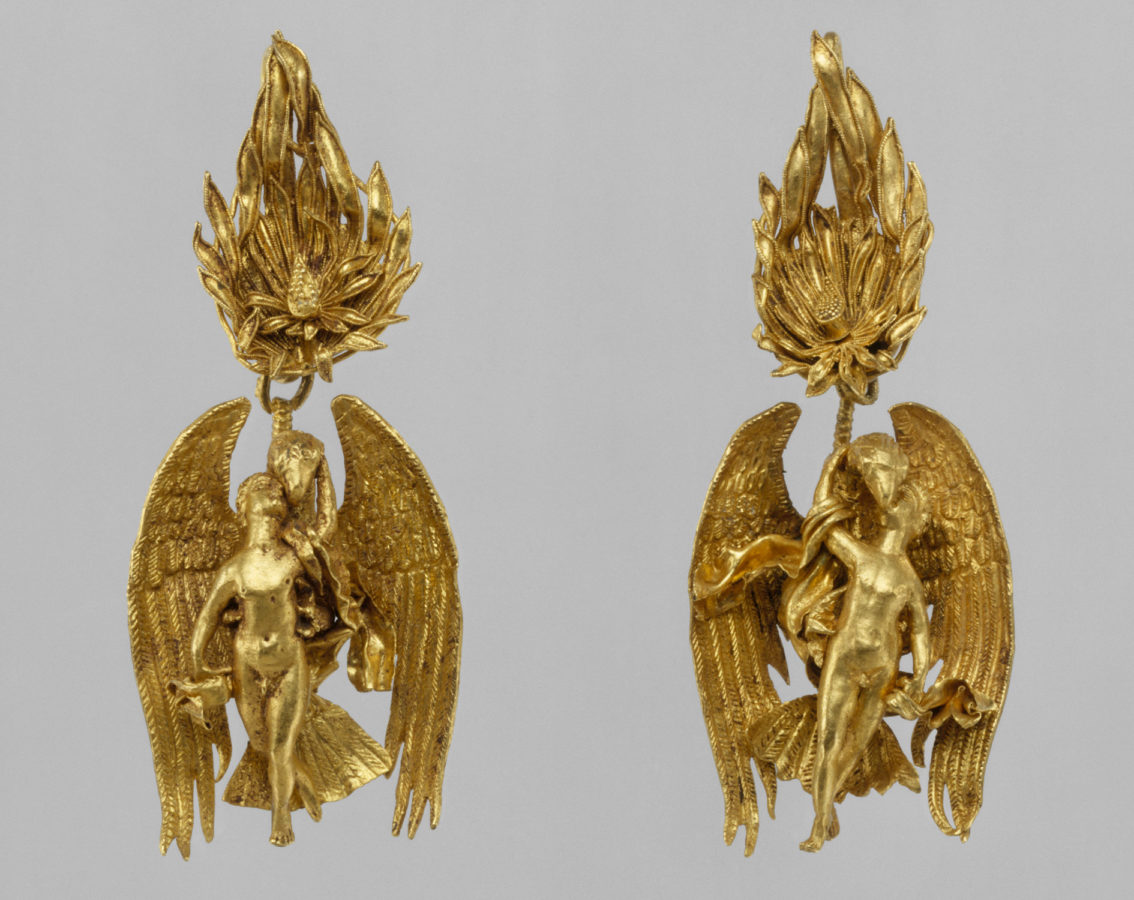 Ganymede Jewelry (earrings), Hellenistic, ca. 330-300 BC, Metropolitan Museum of Art (Heilbrunn Timeline of Art History): New York City, 2019[/explanation] Much of the jewelry in Ancient Hellenic republic, the Hellenistic Period specifically (approx. 323 BC-31BC), was comprised of gold. While gold was used before this period, the arrival of gilded into larger quantities into the circulation of the Hellenistic Catamenia appurtenances marked part of the significance of Alexander the Great's conquering of the Western farsi Empire. Many dissimilar types of jewelry existed during this time: hair ornaments, thigh and arm bands, earrings, rings, pins and pendants, and necklaces. Besides gilded, gemstones, semi-precious stones and pearls often decorated the ornamental pieces. The necklace beneath showcases the use of gold, gemstones, pearls, and an animal design of a butterfly. The different shapes of the gemstones set in gold make this slice stand out. [caption id="attachment_20226" marshal="aligncenter" width="813"]
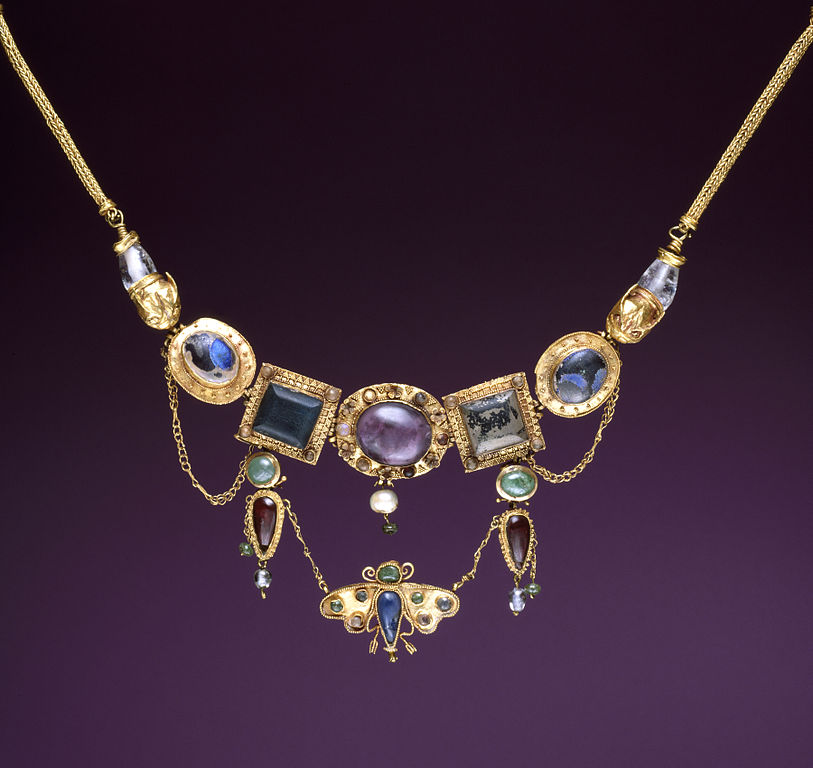 Necklace with Butterfly Pendant, Hellenistic, ca. late 2nd-1st century BC, Walters Art Museum: Baltimore, 2019[/caption]
Motifs in Aboriginal Hellenic republic
Many of the motifs involved Greek gods, or plants and animals, such as the set shown below. The elaborate design(southward) on the fix include Dionysus (the god of wine) and his married woman, Ariadne. As well, the motif on the earrings is of a muse playing a lyre sitting above the crescent shape of the set. [caption id="attachment_20205" align="aligncenter" width="712"]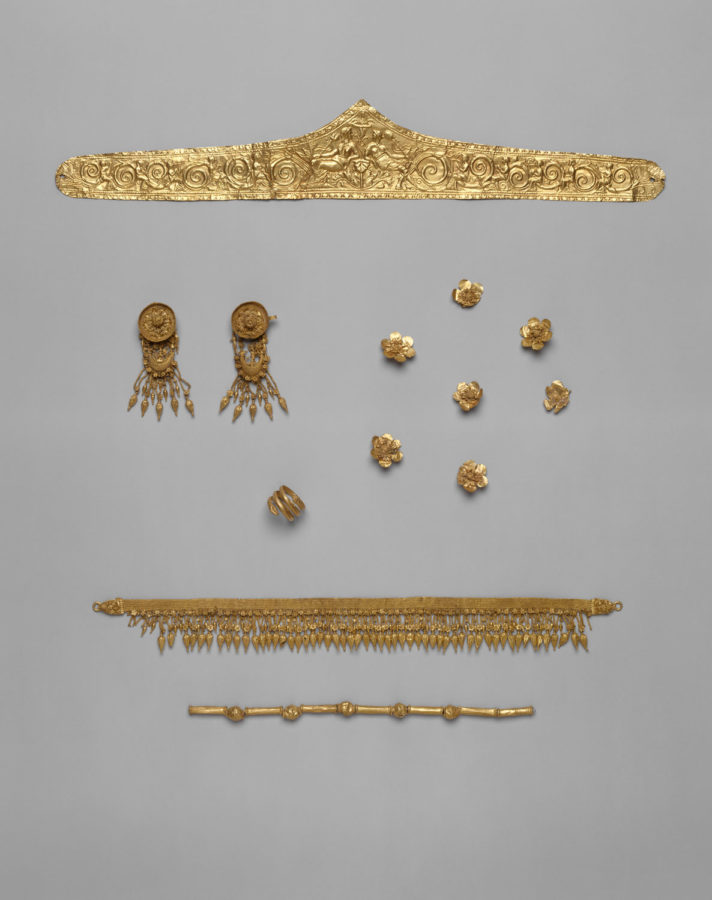 Set of Jewelry, Hellenistic, ca. 330-300 BC, Metropolitan Museum of Art (Heilbrunn Timeline of Art History): New York Urban center, 2019[/caption] Animate being motifs were as common equally those of the gods. Below, two sets of golden rams adorn these bracelets; the heads of the ram(south) extend out of ornately designed collars while the base of operations is made of polished stone-crystal which has been shaped to appear as if information technology is twisting. [explanation id="attachment_20207" align="aligncenter" width="1453"]
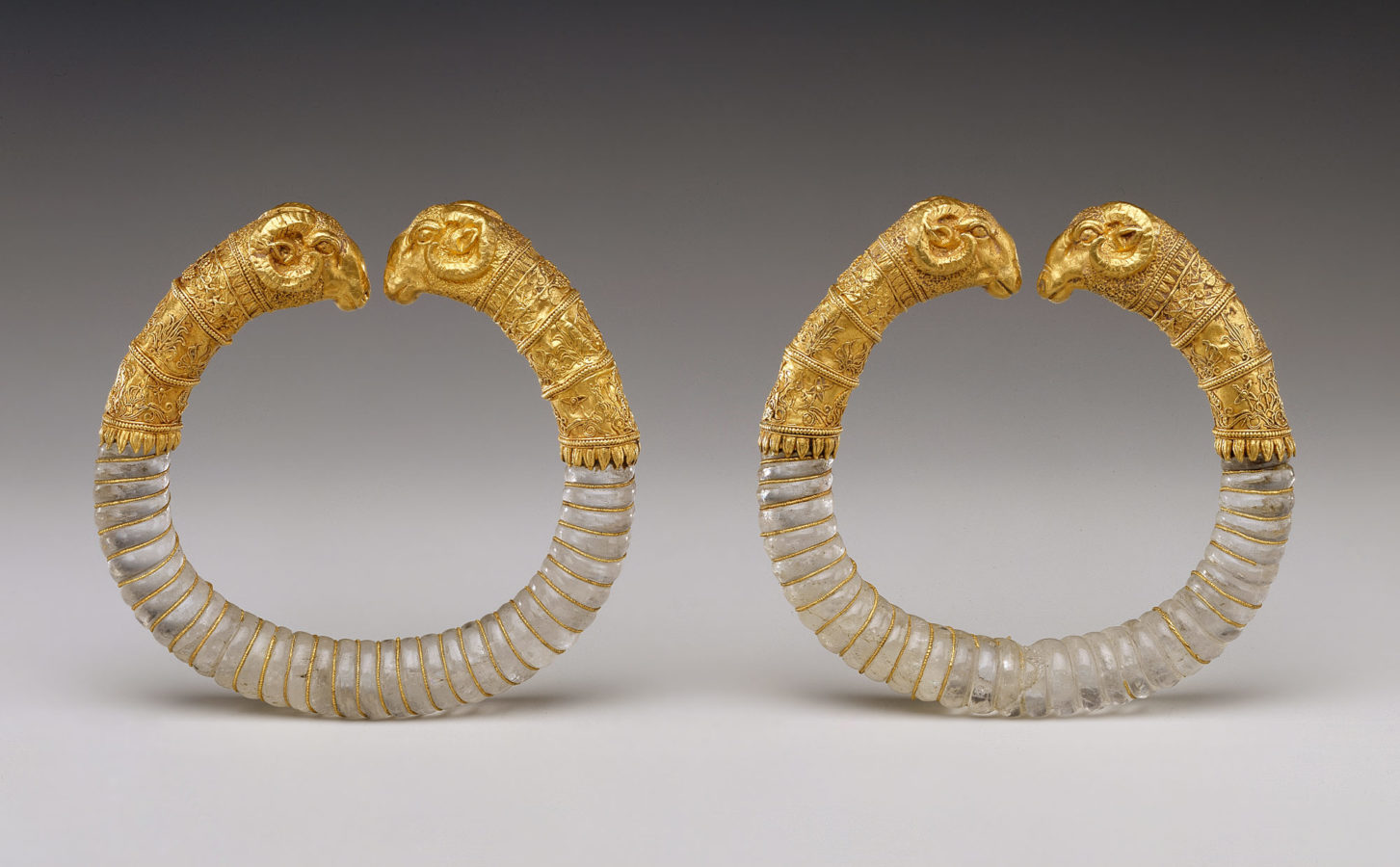 Ganymede Jewelry (bracelets), Hellenistic, ca. 330-300 BC, Metropolitan Museum of Art (Heilbrunn Timeline of Art History): New York City, 2019[/caption] Like the rams' heads above, this necklace located at the Walters Art Museum in Baltimore, Maryland utilizes bull heads in its design. The necklace also uses a garnet gemstone, tying together much of what makes Hellenistic period pieces identifiable and what has been discussed in this commodity thus far...from Persian influences to Ancient Greek motifs. [caption id="attachment_20227" align="aligncenter" width="1024"]
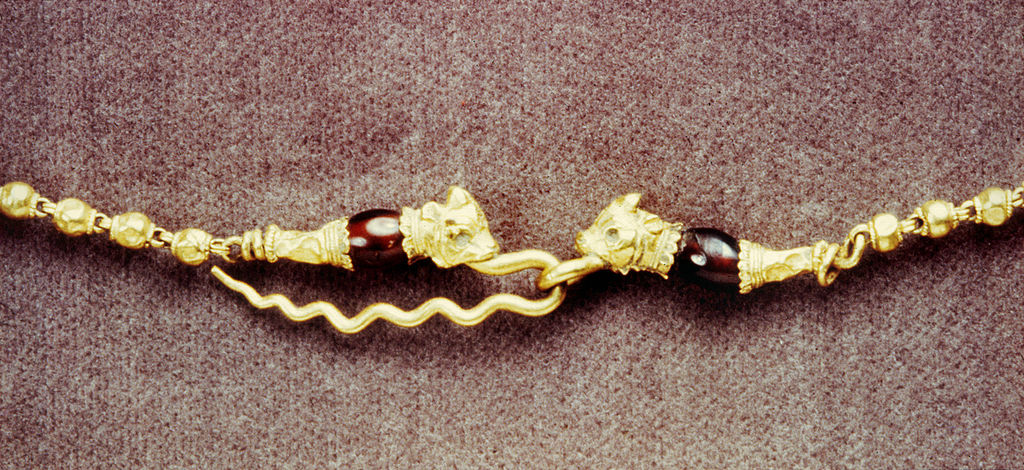 Necklace with Clasp of 2 Bull Heads, Classical-Hellenistic Greek, ca. 4th-third century BC, Walters Fine art Museum: Baltimore, 2019[/caption]
Purpose(southward)
Jewelry was worn both in life and death; pieces were therefore created for both, worn in both, or meant as just a office of burial. Much of the best-preserved pieces of jewelry come from tombs where the dead were cached in their personal pieces. The above necklace with butterfly pendant was establish on the deceased. Because Ancient Greeks believed the butterfly to represent their psyche, or soul, it was often used in burial to represent the leaving of one's soul from their concrete body. However, pieces were oft created with specific purposes in mind; death being merely 1 specific use. Only what about life? And spousal relationship? [explanation id="attachment_20230" align="aligncenter" width="682"]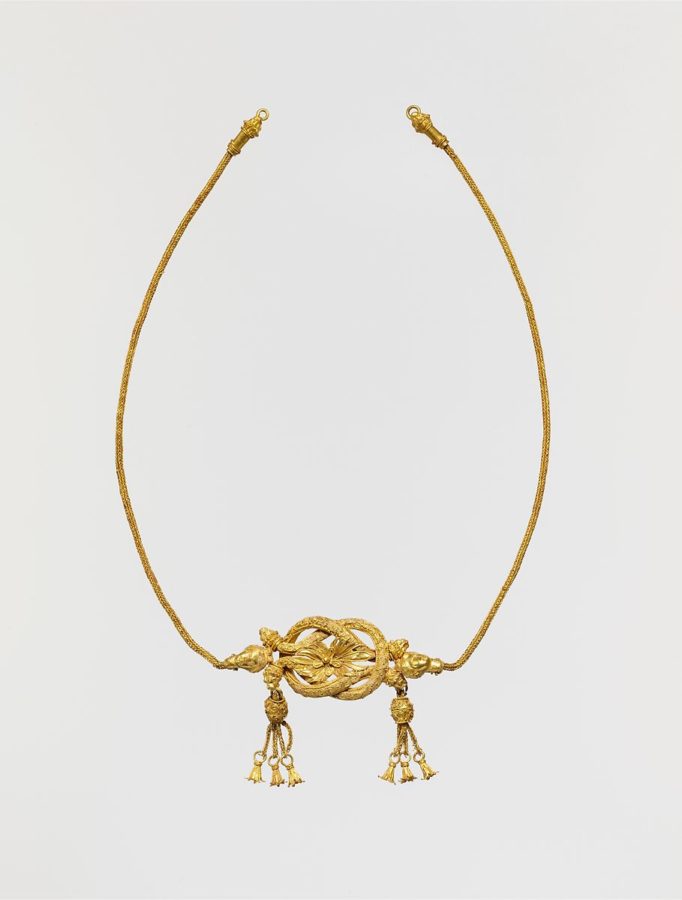 Gilded Fillet with a Herakles knot, Classical-Hellenistic, ca. late 4th-tertiary century BC, Metropolitan Museum of Art: New York City, 2019[/caption] In Ancient Greece, the Herakles Knot is symbolic of union, otherwise known a marriage-knot, and was a representation of the virginity of the helpmate, as the groom would have taken off or untied the knot worn by the helpmate.
Larn more:
[easyazon_image align="none" height="110" identifier="1635610354" locale="UK" src="https://www.dailyartmagazine.com/wp-content/uploads/2019/03/5178DO2XuIL.SL110.jpg" tag="dail005-21" width="110"] [easyazon_image align="none" height="110" identifier="0878468072" locale="Uk" src="https://www.dailyartmagazine.com/wp-content/uploads/2019/03/41Eq49VR3gL.SL110.jpg" tag="dail005-21" width="79"] [easyazon_image align="none" height="110" identifier="0500237778" locale="UK" src="https://www.dailyartmagazine.com/wp-content/uploads/2019/03/51jF2NszcAL.SL110.jpg" tag="dail005-21" width="ninety"]
Source: https://www.dailyartmagazine.com/jewelry-in-ancient-greece/

إرسال تعليق for "Art and Jewelry in China Anicient Art and Jewelry in China"