How Old Was Edgar When He Became an Orphan and Was Taken Away From His Family?
The Tragic Real-Life Story Of Edgar Allan Poe
Shutterstock
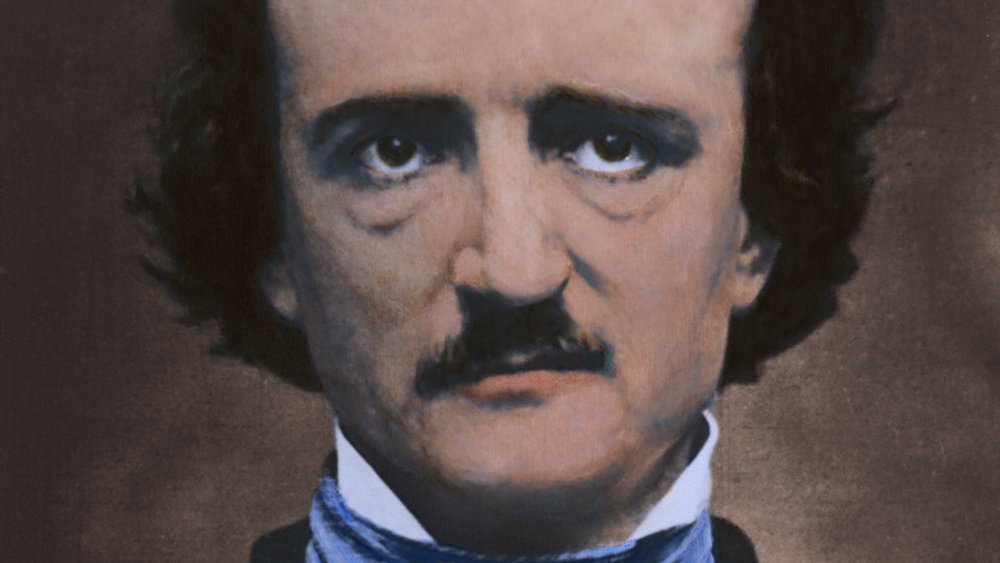
In all of American literature, there might be no chief of the macabre and so historic as Edgar Allan Poe. From his unforgettable, supernatural-tinged poem "The Raven" to the haunting twist at the core of "The Tell-Tale Heart," Poe's style and themes form the crux of nearly all horror stories today. He knew how to create believable characters, place them in eerie settings, and leave the reader feeling chilled to the cadre. Millions of writers owe him a debt of gratitude.
Behind the cloak and daggers of Poe's tales, though, what was the real man similar? While it would exist dainty if the person who wrote such scary fables could take had a happy time on Globe, the tape shows that Poe's short life was instead filled with abiding tragedy, heartbreak, and an enemy who tried to ruin his reputation. The existent Edgar Allan Poe was quite different from the legend, simply no less worthy of study.
Edgar Allan Poe was orphaned at a young age
Shutterstock
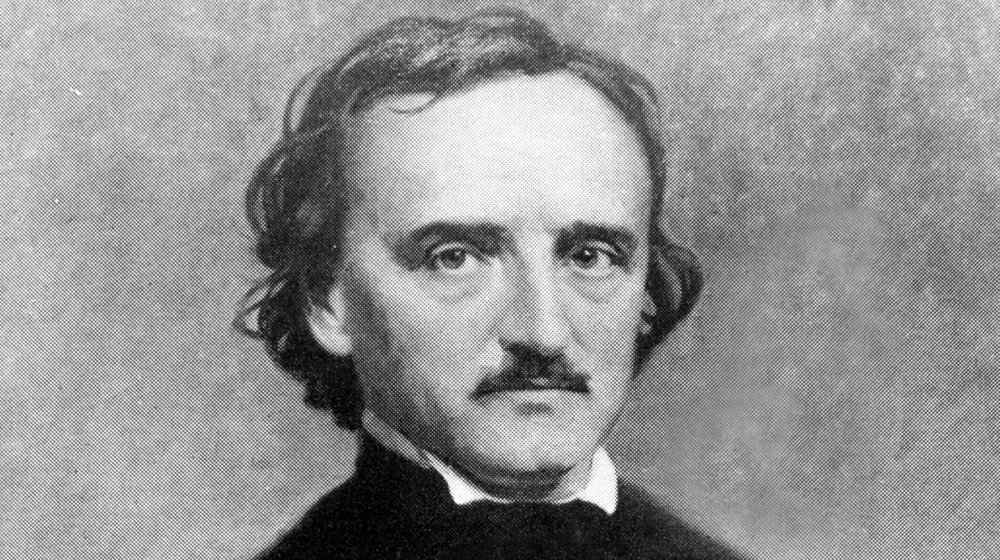
In 1809, a boy named Edgar Poe — notation, no "Allan" — was born to two traveling stage actors, every bit reported by the Edgar Allan Poe Society of Baltimore.
The father was David Poe, Jr., who hailed from a hardcore military family so entrenched in their means that David had to refer to his dad as "General," co-ordinate to Dr. Shelley Costa Bloomfield. Needless to say, these folks weren't happy when Junior fell in love with the talented thespian Eliza Arnold, nor when he followed her onto the stage for his ain artsy career. Once married, the couple had two sons: William and Edgar. The latter boy was named after a character in Shakespeare's playRex Lear, which the couple was performing at the time.
Sadly, David wasn't a good father. His struggles with heavy drinking, fighting, and fiscal hardship were stressful enough, but he as well may take too resented Eliza's far more successful acting career. Whatever his problems may accept been, he deserted his family unit, leaving Eliza alone to raise the children. Past the time young Edgar was 3-years-quondam, Eliza came down ill and died. Obviously, David died soon afterwards, though the circumstances of his demise are unknown. Regardless, this left the immature children with no parents, and no safety place to go.
Edgar Allan Poe had a horrendous adoptive male parent
Edgar Poe was soon adopted past the Allan family: hence, he became Edgar "Allan" Poe. Unfortunately, while he got along well with his adoptive female parent Frances, the thorny connection to his new dad John Allan proved to be a source of conflict, misery, and heartbreak for much of Poe's life.
Allan, a wealthy tobacco merchant, wanted Poe to follow him into the family business, according to Biography, and was thus highly dismissive of Poe's literary passions. Poe, in plough, rebelled by writing poems on the dorsum of Allan'south business papers. The relationship further soured equally Poe grew older, equally seen in letters preserved past the National Park Service, when Allan repeatedly refused to lend Poe necessary financial assistance — despite frequent, desperate pleading from Poe — leading to the academically successful boy being unable to afford his classes, falling deep into debt, and becoming increasingly destitute. Allan, for his part, seems to have been remarkably dismissive of the boy'due south concerns. He one time wrote Poe off as "quite miserable, sulky & ill-tempered," and bizarrely touted how magnanimous he'd been for paying for Poe's education fifty-fifty though he was the 1 whose lack of support, in fact, had caused Poe's hardships. Not the kind of guy you want as a dad, that's for certain.
It's worth noting that, despite taking Poe in, Allan never legally adopted the boy. This spiteful move caused deeper rifts down the line.
Edgar Allan Poe was in a 'Stacy'south Mom' state of affairs
Due to the fact that Poe was so horribly young when his female parent perished, he spent much of his early years trying to connect with substitute mother figures, the most notable being his foster female parent Frances Allen. According to the Edgar Allan Poe Society of Baltimore, another of these was Jane Stith Stanard, the mother of his friend Robert, though it has been speculated — with notable testify — that Poe, when he was going through puberty, may have developed deeper feelings for her. When situations turned stressful at the Allan household, every bit they oft did, it was Stanard whom Poe would become to for support, and while obviously no true romantic relationship could ever class — this was, at its core, a teenage beat out — Poe did have enormous love and respect for her: in addition to writing a poem that subtly compared her to Helen of Troy, Poe would, years later, depict her as "the get-go, purely ideal honey of my soul."
Sadly, as would happen to so many close people in Poe's life, Stanard died from illness at a immature age, in 1824. Poe was still merely a teenager.
Edgar Allan Poe'due south armed forces career
Hulton Annal/Getty Images
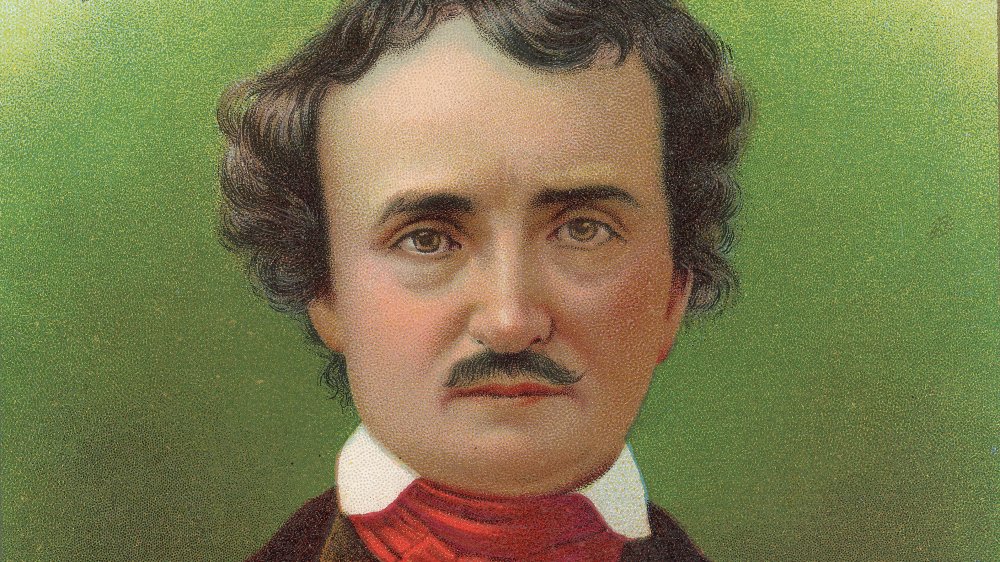
When Edgar Allan Poe was drowning in debt, starving, and receiving no assistance from John Allan, he turned to a last-ditch solution: according to Mental Floss, he took the false identity of Edgar A. Perry, claimed to be a 22-twelvemonth-old Boston clerk, and signed upward for a v-year stint with the U.S. Army.
Poe excelled in the war machine. He also hated it. Later on 2 years of moving upwards and downwardly the Due east Coast, making $5 a month, and beingness promoted to sergeant major for arms, Poe was desperate for a way out, and confessed his true story to his commanding officer. Miraculously, the officer was okay with letting Poe out early on ... but, non-and then-miraculously, he stipulated that Poe had to first make amends with his obnoxious adoptive father. Ugh.
Undeterred, Poe began writing letters to Allan. Allan, being the jerk he was, didn't answer. However, the death of Frances Allan forced the 2 men to reconcile, at which point Allan agreed to let Poe leave the service early on ... and then long as he enrolled at West Point, the Usa Military University. Sigh. Poe did as was asked, and excelled in his studies, merely when Allan remarried, Allan close down communication with him. Poe wanted out of military life for real this time, merely over again, he needed Allan's limited permission to go out, and Allan wouldn't give it. And so Poe solved the problem by flunking his studies, existence as insubordinate every bit possible, and purposely getting himself kicked out of Due west Point.
Edgar Allan Poe had an on-again/off-again romance
Perhaps the nearly continual thread running through Edgar Allan Poe'south love life, from beginning to terminate, was a woman named Sarah Elmira Royster Shelton. She was, essentially, Poe'southward first and last dear. Unfortunately, the two never married, and their relationship ever hitting some, well, snags.
Sarah and Edgar were childhood friends and neighbors, according to the National Park Service, who became engaged equally teenagers. When Poe left to attend the University of Virginia, the ii star-crossed lovers continued with an epistolary romance ... which came to a crashing halt when Royster's male parent caught wind, according to the Odyssey. James Royster did not want an orphan similar Poe as a son-in-law, most likely, so he intercepted their letters and left both kids thinking the other had ghosted them. When Poe returned home, possibly hoping to reunite with her, he instead found that she had married a wealthier homo in his place. Many have speculated, based on this sad tale, that Sarah may be the long lost Lenore mentioned throughout "The Raven."
However, their romance didn't end there. When Royster Shelton'south husband died in 1848, Poe reached out to her over again, and they rekindled their romance. His initial (or, well, second) proposal was rebuffed, but a few months subsequently, she accepted. Tragically, the hymeneals bells never rang out, considering ten days before the nuptials, Poe died.
Edgar Allan Poe was the classic 'starving artist'
Saul Loeb/Getty Images
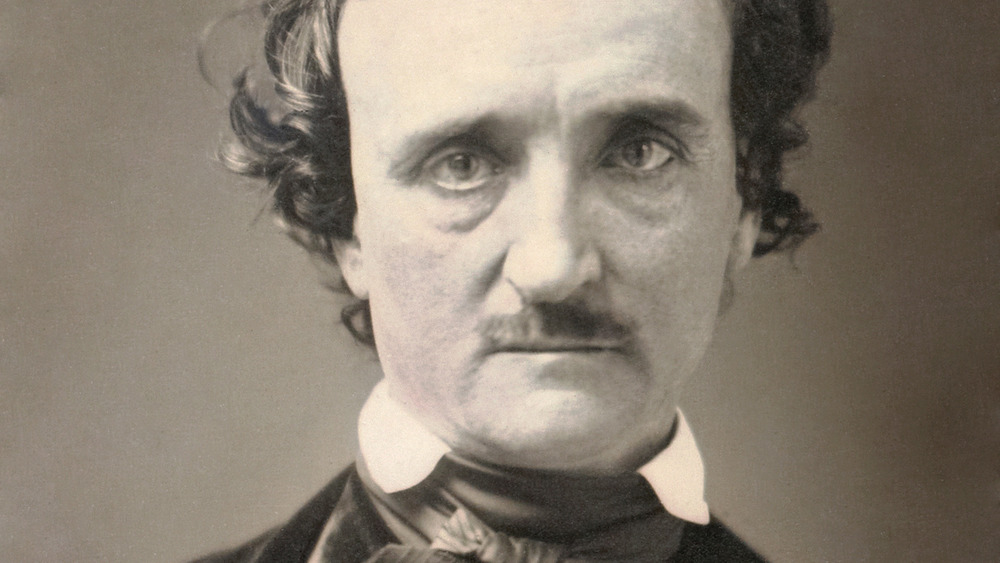
When you hear about famous artists who, despite irresolute the world, struggled to catch a break, well, Edgar Allan Poe should be about the top of the list. Despite Poe's magnificent talent, and a fierce want for success, he spent much of his life in poverty, and his work was consistently undervalued. Co-ordinate to Mental Floss, his first verse collection, Tamerlane, ended upwards being a fiscal disaster, which probably wasn't helped by his unwise conclusion to use the pseudonym "A Bostonian." His second volume, Poems, just got off the basis when Poe convinced at least 131 fellow cadets in the Regular army to requite him a buck and a quarter to get it running. Fifty-fifty when he was shopping for a publisher for his landmark poem, "The Raven," the Vintage News says that i magazine not simply rejected it, only gave Poe $fifteen in sympathy cash. When he finally sold the verse form to The American Review, information technology netted only $9.
Fortunately, "The Raven" made Poe mainstream plenty to live every bit a professional writer. He became a household name, according to the Poe Museum, gave lectures, and ran his own magazine. Non and so fortunately, his personal life was a mess — the health of his wife, Virginia, worsened by the day — and his finances weren't specially sturdy. According to the Edgar Allan Poe Social club of Baltimore, his almanac bacon totaled $624. With inflation in mind, that'due south equivalent to under $xx g, in today's economy.
Quoth the raven, 'Nevermore'
Decease happens. Haunting as it may be, it's quite ordinary. Information technology'due south the inevitable determination to every life story. That said, the sheer number of tragic, heartbreaking deaths that Edgar Allan Poe faced in his life — to say nothing of his ain death — were far more than ordinary. Looking past the early on deaths of his parents and Mrs. Stanard, another tragedy in the young Poe's life was the loss of his foster mother, Frances, who loved him like John Allan didn't. Co-ordinate to the Edgar A. Poe Calendar, Poe was completely unaware of her failing health, and when she died, the Ground forces discharged him so belatedly that he missed the funeral.
Years afterwards, Poe's first wife passed away due to fatal complications from tuberculosis, according to Biography, which was the same illness that killed his mother and his blood brother. Another incident that particularly stung was the expiry of John Allan. After all those years of feuding, Allan elected to leave Poe with no inheritance, while instead providing for an unknown kid, born out of spousal relationship, who Poe had never met, despite the fact that Poe was, at this time, living bankrupt and penniless.
Was Edgar Allan Poe an alcoholic or a drug addict?
Needless to say, Edgar Allan Poe had a hard life. He suffered from a lack of unconditional love, a troubled upbringing, and no reliable support system. Because of these struggles, according to Britannica, he often turned to alcohol, specially when dealing with stressful social situations that required him to be in a skillful mood effectually people. While it's incommunicable to properly diagnose someone who lived hundreds of years ago, it does seem probable that Poe was an alcoholic. He drank more ofttimes than his peers, and while he didn't commonly accomplish the point of beingness inebriated, his drunken instances always seemed to occur, embarrassingly enough, on the public stage.
Still, the reality of Poe's very genuine suffering is oft clouded by the false stories told by those who disliked him. Poe'south enemies oftentimes tried to pigment him equally a town drunk, a drug addict, or someone who just wrote nether the influence of chemical stimulants. None of these things were true, according to the Edgar Allan Poe Society of Baltimore: as far every bit drugs get, Poe simply seems to have occasionally used opium for medical purposes, as was mutual in that time, and once claimed to take taken drugs equally part of a suicide attempt. So either fashion, while Poe may have been an alcoholic, he absolutely was not a drug addict.
Only the expert die young
Saul Loeb/Getty Images
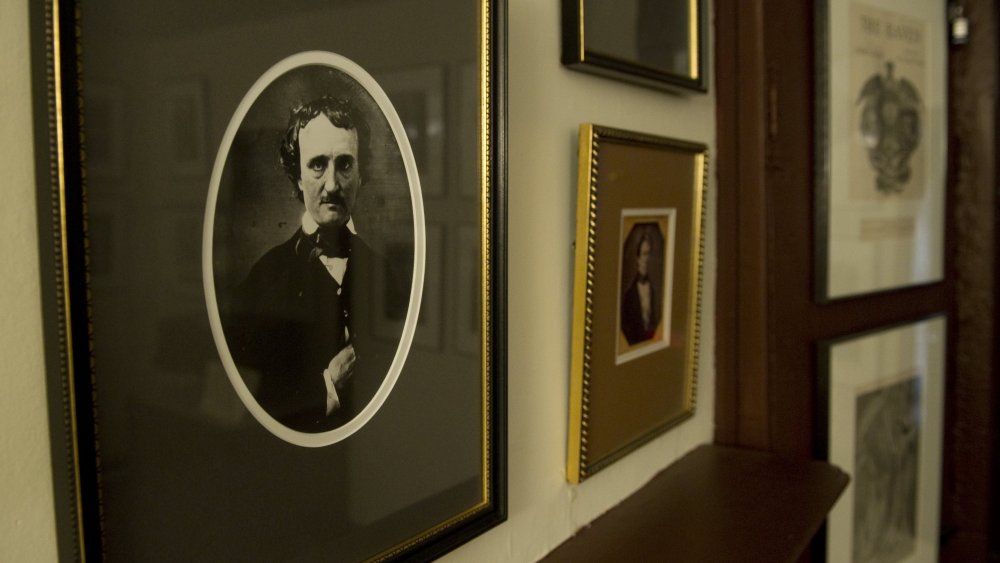
Edgar Allan Poe was only 40 when he died, less than ii weeks abroad from marrying his beloved Sarah. He was young, destitute for much of his life, criticized past his peers, and often unhappy.
Perhaps the most troubling matter about Poe's expiry, though, is that the circumstances remain a mystery. A week beforehand, according to Biography, his fiancée expressed concerns about his wellness, and his doctor told him not to travel. He did, anyhow. Foreign lapses in Poe's behavior occurred at this time — for case, he completely misplaced his luggage, and was unable to find it — until he was suddenly discovered sprawled out in the gutter outside a voting booth location, according to the Smithsonian, wearing someone else's clothes, unable to movement, and screaming at hallucinations. During this pained time, he repeatedly chosen out for some unknown figure named "Reynolds," and died four days later.
What happened? As History explains, many people were quick to blame booze, but his attention physician disputed this. Various diseases have been suggested, such every bit tuberculosis and encephalon lesions. One of the most prevalent theories, due to the voting berth location where Poe was institute, is that he may have been a victim of something called "cooping," a horrifying voter fraud scam from the time: cooping occurred when decadent politicians paid criminals to drug and poison innocent bystanders, particularly the homeless, and then forced them to vote at location after location until they dropped dead.
Edgar Allan Poe couldn't catch a interruption even in death
Kris Connor/Getty Images
Sadly, Edgar Allan Poe's mistreatment did non cease afterwards his death.
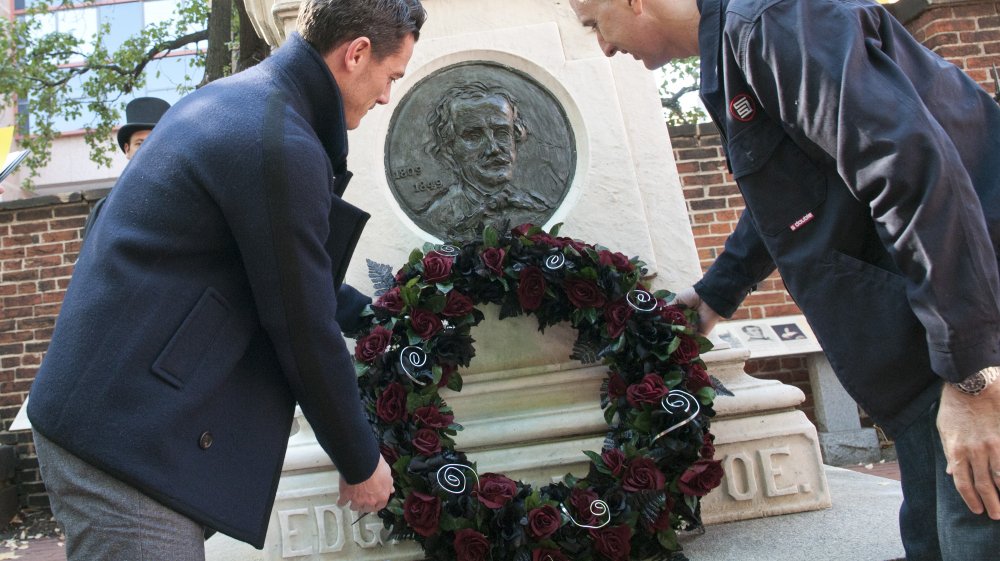
Co-ordinate to Biography, his funeral was hastily conducted only a day after his death, resulting in only seven people attending, one of whom had nil but nasty words about the author. Initially buried in an unmarked grave, it took xi years for Poe's cousin to buy a existent monument for him, simply before the piece could be mounted, it was destroyed when ... uh, a speeding train came off its rails, and crashed directly into the rock carver'south place of business. Can't make this stuff up. It took nearly iii decades before an assembly of students and teachers collected the funds to give Poe the monument he deserved, and even and so, his bury accidentally shattered to pieces during the transfer. Seriously?
Information technology was around this same time that, finally, Poe's deceased wife was buried beside him: until that indicate, her remains had been placed in their landlord's family cemetery, which had after been congenital over past developers. Since then, thankfully, both of them accept remained in their rightful place.
Edgar Allan Poe's biggest hater shaped his legacy
Much of the darker Edgar Allan Poe legends and myths that circulate today, sadly, stalk non from the writer's life, but his obituary. This mean-spirited block of text was penned past the Reverend Rufus Griswold. The not-and so-holy man wrote this obituary under the pen name Ludwig, and he made sure information technology was filled with outright slander that portrayed Poe every bit existence the drunken, drug-fond, unsavory character that many still paint him as today.
Griswold, as i might imagine, had a personal reason for besmirching the expressionless, as explained by the Poe Museum. Over the years, the two men had gone dorsum and along betwixt beingness friends, enemies, and literary rivals, and Poe's public critiques of Griswold'due south work, when he was running his magazine The Messenger, did not go forgotten. At present, in the 21st century, whatever writer should exist brash not to get fidgety nearly negative reviews: they happen, and it's okay. Griswold, though, was such a bitter trivial man that he followed his nasty, deceptive obituary an every bit nasty, deceptive biography nearly Poe'southward entire life.
Ironically, Griswold's portrait of Poe equally a dark, disturbed effigy ended up increasing his enemy'due south posthumous fame, while Griswold himself has now become a mere footnote in literary history ... which is, frankly, an appropriate fate for such a major league jerk.
Edgar Allan Poe has not been forgotten
In life, Edgar Allan Poe did not receive the full recognition he deserved. In death, though, he has been hailed as America's Shakespeare, according to American Heritage Trees, and many of the lies that "Ludwig" spread about him have been publicly dismissed. There are museums and societies defended to Poe'south life, and works like "The Pit and the Pendulum" were probably your favorite stories that you studied in high schoolhouse English.
Perhaps the virtually astonishing tribute to Poe'southward legacy was the example set by an bearding person identified as "the Poe Toaster." From 1948 until 2009, according to the Smithsonian, this masked effigy rose from the shadows once a year, on the anniversary of Poe'south birthday, to exit a canteen of cognac and three red roses on the author'due south grave. Who was the Poe Toaster? Nobody knows. The Poe Toaster never sought fame or attention, fifty-fifty as an increasingly big crowd of onlookers began taking note of his annual ritual, and it is believed that the original Toaster may accept actually retired in 1999, passing the mantle down to his son.
The 2009 end of this tradition, it is speculated, may exist due to increased media attention. These days, bluntly, all grand mysteries tend to get killed by Twitter and Facebook. That said, this tradition has been continued by the Maryland Historical Gild, who now send their ain Poe Toaster to the author'south grave every year, to pay their respects to one of dark literature's greatest champions.
Source: https://www.grunge.com/170816/the-tragic-real-life-story-of-edgar-allan-poe/

إرسال تعليق for "How Old Was Edgar When He Became an Orphan and Was Taken Away From His Family?"