Slave Dennis Again Part 2 Ruscapturedboys
Slaves of the State
Blackness Incarceration from the Chain Gang to the Penitentiary
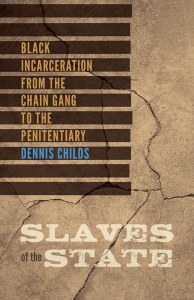
A sweeping cultural history of U.S. prison slavery
In Slaves of the State Dennis Childs argues that the incarceration of black people and other historically repressed groups in chain gangs, peon camps, prison plantations, and penitentiaries represents a ghostly perpetuation of chattel slavery. With more than 2.3 meg people in the country'southward jails, prisons, and immigrant detention centers, Childs exposes slavery as a continuing social reality of U.S. empire.
Slaves of the State cannot receive enough superlatives: middle-opening, deeply disturbing, intellectually stimulating, terrible, brilliant. Dennis Childs has written a moving and intricately researched book, which weaves novels and memory, the past and the present, ancient artifacts and modern tools of repression to reveal an unwelcome truth about modern day America and the biggest prison arrangement on globe.
—
Mumia Abu-Jamal, author of Writing on the Wall: Selected Prison house Writings of Mumia Abu-Jamal
The Thirteenth Amendment to the United States Constitution, passed in 1865, has long been viewed as a definitive break with the nation'due south by past abolishing slavery and ushering in an inexorable march toward black freedom. Slaves of the State presents a stunning counterhistory to this linear narrative of racial, social, and legal progress in America.
Dennis Childs argues that the incarceration of black people and other historically repressed groups in concatenation gangs, peon camps, prison house plantations, and penitentiaries represents a ghostly perpetuation of chattel slavery. He exposes how the Thirteenth Amendment's exception clause—allowing for enslavement as "penalization for a crime"—has inaugurated forms of racial capitalist misogynist incarceration that serve every bit haunting returns of conditions Africans endured in the barracoons and slave send holds of the Center Passage, on plantations, and in chattel slavery.
Childs seeks out the historically muted voices of those entombed within terrorizing spaces such equally the concatenation gang rolling cage and the modernistic alone confinement cell, engaging the writings of Toni Morrison and Chester Himes besides as a broad range of archival materials, including landmark court cases, prison house songs, and testimonies, reaching back to the birth of mod slave plantations such every bit Louisiana'due south "Angola" penitentiary.
Slaves of the State paves the way for a new understanding of chattel slavery equally a continuing social reality of U.S. empire—ane resting at the very foundation of today's prison industrial complex that at present holds more than 2.iii million people within the country'due south jails, prisons, and immigrant detention centers.
Slaves of the State cannot receive enough superlatives: eye-opening, deeply disturbing, intellectually stimulating, terrible, bright. Dennis Childs has written a moving and intricately researched book, which weaves novels and retentivity, the by and the nowadays, ancient artifacts and mod tools of repression to reveal an unwelcome truth nearly modern mean solar day America and the biggest prison organization on earth.
—
Mumia Abu-Jamal, author of Writing on the Wall: Selected Prison house Writings of Mumia Abu-Jamal
Dennis Childs 'digs a ditch' in Slaves of the Land, laboring to present the tortured captives of chain gangs and penitentiaries in ways that bring the captors to shame. With incisive scholarship, Childs analyzes the terrors of black incarceration and trauma. This daring book simplifies a democracy corrupted past penal enslavement. Its haunting critique of the racial-sexual production of misery and ghosts, through the 'terrorizing structure of US penal police force,' needs to be read, and remembered.
—
Joy James, writer of Seeking the Dearest Community
Childs has written a securely moving and intricately researched book, which weaves novels and memory, the past and the present, ancient artifacts and modern tools of repression, to reveal an unwelcome truth about modern-twenty-four hours America, and the biggest prison organization on earth.
Contents
Introduction. "Inhuman Penalty": The (Un)dead Book of Chattel Carcerality
1. "You lot Ain't Seen Nothin' Yet": Dearest and the Middle Passage Carceral Model
ii. "Except as Penalization for a Criminal offence": The Thirteenth Amendment and the Rebirth of Chattel Imprisonment
3. Angola Penitentiary: The Once and Futurity Slave Plantation
4. The Warfare of Northern Neoslavery in Chester Himes'due south Yesterday Volition Brand Yous Cry
Acknowledgments
Notes
Index
Source: https://www.upress.umn.edu/book-division/books/slaves-of-the-state
إرسال تعليق for "Slave Dennis Again Part 2 Ruscapturedboys"