Two Criminals on the Run Clip Art De Age
| Bicycle Thieves | |
|---|---|
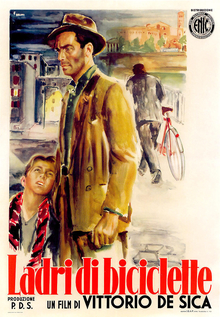 Theatrical release poster | |
| Directed by | Vittorio De Sica |
| Screenplay by |
|
| Story past | Cesare Zavattini |
| Based on | Bicycle Thieves past Luigi Bartolini |
| Produced by |
|
| Starring |
|
| Cinematography | Carlo Montuori |
| Edited by | Eraldo Da Roma |
| Music by | Alessandro Cicognini |
| Production | Produzioni De Sica[2] |
| Distributed past | Ente Nazionale Industrie Cinematografiche |
| Release date |
|
| Running time | 89 minutes |
| Country | Italy |
| Language | Italian |
| Upkeep | $133,000[3] |
| Box office | $428,978[four] |
Wheel Thieves (Italian: Ladri di biciclette ; sometimes known in the United States as The Bicycle Thief )[v] is a 1948 Italian neorealist drama moving-picture show directed by Vittorio De Sica.[6] It follows the story of a poor father searching in post-World War II Rome for his stolen bicycle, without which he will lose the task which was to be the salvation of his young family.
Adjusted for the screen by Cesare Zavattini from the 1946 novel by Luigi Bartolini, and starring Lamberto Maggiorani every bit the desperate father and Enzo Staiola equally his plucky young son, Bicycle Thieves received an Academy Honorary Honour (virtually outstanding foreign language film) in 1950, and in 1952 was deemed the greatest motion picture of all fourth dimension past Sight & Sound mag's poll of filmmakers and critics;[vii] fifty years later on another poll organized past the same magazine ranked information technology sixth among the greatest-ever films.[8] In the 2012 version of the list the film ranked 33rd among critics and 10th among directors. The film was also cited by Turner Classic Movies as i of the most influential films in cinema history,[9] and it is considered part of the catechism of archetype cinema.[10] In 1958, the film was voted number 3 on the prestigious Brussels 12 list at the 1958 World Expo.
Plot [edit]
In the postal service-World War 2 Val Melaina neighborhood of Rome, Antonio Ricci (Lamberto Maggiorani) is drastic for work to support his wife Maria (Lianella Carell), his son Bruno (Enzo Staiola) and his small-scale baby. He is offered a job of pasting advertising bills merely tells Maria that he cannot accept because the task requires a bike. Maria resolutely strips the bed of her dowry bedsheets—prized possessions for a poor family—and takes them to the pawn store, where they bring enough to redeem Antonio's pawned cycle.
On his first day of work, Antonio is atop a ladder when a boyfriend (Vittorio Antonucci) snatches the bicycle. Antonio gives hunt but is thrown off the trail past the thief's confederates. The constabulary warn that there is lilliputian they tin practise. Brash that stolen goods frequently surface at the Piazza Vittorio market, Antonio goes in that location with several friends and Bruno. They find a bicycle that might exist Antonio'southward, but the series numbers do non friction match.
At the Porta Portese market, Antonio and Bruno spot the thief with an onetime man. The thief eludes them and the quondam human being feigns ignorance. They follow him into a church where he too slips away from them.
In a subsequent run into with the thief, Antonio pursues him into a brothel, whose denizens eject them. In the street, hostile neighbors get together equally Antonio accuses the thief, who conveniently falls into a fit for which the crowd blames Antonio. Bruno fetches a policeman, who searches the thief'southward apartment without success. The policeman tells Antonio the case is weak—Antonio has no witnesses and the neighbors are sure to provide the thief with an alibi. Antonio and Bruno leave in despair amid jeers and threats from the crowd.
On their way home, they are walking near Stadio Nazionale PNF football stadium. Antonio sees an unattended wheel most a doorway and afterward much anguished soul-searching, instructs Bruno to take the tram to a end nearby and await. Antonio circles the unattended cycle and jumps on it. Instantly the hue and cry is raised and Bruno – who has missed the tram – is stunned to meet his father pursued, surrounded and pulled from the cycle. As Antonio is being muscled toward the police station, the wheel's owner notices Bruno and in a moment of compassion tells the others to release Antonio.
Antonio and Bruno then walk off slowly among a buffeting oversupply. Antonio fights back tears and Bruno takes his hand. The camera watches from behind equally they disappear into the crowd.
-

The bike redeemed, the family unit saved
-

First day on the chore
-

In search of the stolen bike
-
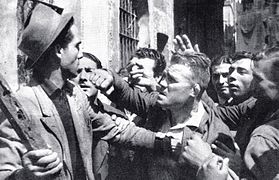
The thief's neighbors threaten Antonio
-

All seems lost
Cast [edit]
Production [edit]
Bicycle Thieves is the best-known work of Italian neorealism, the motility that formally began with Roberto Rossellini'due south Rome, Open Urban center (1945) and aimed to give cinema a new degree of realism.[11] De Sica had just made Shoeshine (1946), simply was unable to go financial backing from any major studio for the film, and then he raised the money himself from friends. Wanting to portray the poverty and unemployment of mail service-war Italy,[12] he co-wrote a script with Cesare Zavattini and others using but the title and few plot devices of a piddling-known novel of the time by poet and artist Luigi Bartolini.[thirteen] Following the precepts of neorealism, De Sica shot only on location (that is, no studio sets) and cast only untrained nonactors. (Lamberto Maggiorani, for example, was a factory worker.) That some actors' roles paralleled their lives off screen added realism to the pic.[xiv] De Sica cast Maggiorani when he had brought his young son to an audition for the film. He afterward cast the 8-yr-old Enzo Staiola when he noticed the young male child watching the moving-picture show'southward production on a street while helping his father sell flowers. The film'due south final shot of Antonio and Bruno walking abroad from the camera into the distance is an homage to many Charlie Chaplin films, who was De Sica's favourite filmmaker.[15]
Uncovering the drama in everyday life, the wonderful in the daily news.
—Vittorio De Sica in Abbiamo domandato a De Sica perché fa un film dal Ladro di biciclette (We asked De Sica why he makes a movie on the Cycle Thief) – La fiera letteraria, half-dozen/2/48
Translated title [edit]
The original Italian title is Ladri di biciclette. It literally translates into English as Bicycles Thieves, as there is no definite article and both ladri and biciclette are plural. The motion picture was released equally Bicycle Thieves in the United States and the United kingdom of great britain and northern ireland.[ citation needed ] The affiche titles were The Bicycle Thief in the U.s.a. and The Bicycle Thieves in the Britain.[16] [ better source needed ]
Bosley Crowther used The Cycle Thief in his 1949 review in The New York Times,[5] and as a result[ citation needed ] this came to be the title by which the pic was known in the United States, and some people became attached to it.[ citation needed ] When the picture was re-released in the late-1990s, Bob Graham, staff motion picture critic for the San Francisco Chronicle, was quoted as proverb that he preferred the title The Wheel Thief, stating, "Purists have criticized the English title of the movie equally a poor translation of the Italian ladri, which is plural. What blindness! The Bike Thief is 1 of those wonderful titles whose power does non sink in until the film is over".[17]
According to critic Philip French of The Observer, the alternative title The Bike Thief is misleading, "because the desperate hero eventually becomes himself a bike thief".[18] The 2007 Criterion Collection release in Due north America uses the plural title.[nineteen]
De Sica changed many aspects of Bartolini's novel, simply retained the title, which used the plural form and referred, in the book, to a post-war culture of rampant thievery and disrespect for civil order countered only by an inept police force strength and indifferent centrolineal occupiers.[xx]
Critical reception [edit]
When Bicycle Thieves was released in Italy, information technology was viewed with hostility and as portraying Italians in a negative way. Italian critic Guido Aristarco praised it, but besides complained that "sentimentality might at times accept the place of artistic emotion." Fellow Italian neorealist moving picture director Luchino Visconti criticized the film, saying that it was a mistake to employ a professional person histrion to dub over Lamberto Maggiorani's dialogue.[xv] Luigi Bartolini, the author of the novel from which de Sica drew his title, was highly critical of the film, feeling that the spirit of his book had been thoroughly betrayed because his protagonist was a middle-class intellectual and his theme was the breakdown of civil order.[20]
Wheel Thieves has continued to gain very high praise from critics, with the review aggregator website Rotten Tomatoes reporting 99% of 67 gimmicky reviews as positive, with an average rating of 9.20/10. The site'due south critics consensus reads, "An Italian neorealism exemplar, Bicycle Thieves thrives on its not-flashy performances and searing emotion."[21] The picture is also in the Vatican'due south Best Films Listing for portraying humanistic values.[22]
Bosley Crowther, film critic for The New York Times, lauded the film and its bulletin in his review. He wrote, "Once again the Italians have sent u.s.a. a bright and devastating motion-picture show in Vittorio De Sica'due south rueful drama of modern city life, The Bicycle Thief. Widely and fervently heralded by those who had seen it abroad (where information technology already has won several prizes at diverse pic festivals), this centre-tearing picture of frustration, which came to [the World Theater] yesterday, bids off-white to fulfill all the forecasts of its absolute triumph over here. For once more the talented De Sica, who gave us the shattering Shoeshine, that desperately tragic demonstration of juvenile abuse in post-state of war Rome, has laid hold upon and sharply imaged in elementary and realistic terms a major—indeed, a central and universal—dramatic theme. Information technology is the isolation and loneliness of the footling man in this complex social world that is ironically blessed with institutions to condolement and protect flesh".[5] Pierre Leprohon wrote in Cinéma D'Aujourd that "what must non be ignored on the social level is that the character is shown not at the outset of a crisis but at its upshot. One need only to look at his face up, his uncertain gait, his hesitant or fearful attitudes to understand that Ricci is already a victim, a diminished man who has lost his conviction." Lotte Eisner chosen it the all-time Italian flick since World State of war Two and Robert Winnington called information technology "the nearly successful record of any foreign film in British cinema."[15]
When the flick was re-released in the late 1990s Bob Graham, staff film critic for the San Francisco Relate, gave the drama a positive review: "The roles are played past non-actors, Lamberto Maggiorani equally the father and Enzo Staiola as the solemn boy, who sometimes appears to exist a miniature man. They bring a grave dignity to De Sica'south unblinking view of post-war Italy. The wheel of life turns and grinds people down; the man who was riding high in the morning is brought low by nightfall. It is impossible to imagine this story in any other course than De Sica'south. The new blackness-and-white print has an boggling range of grayness tones that get darker as life closes in".[17] In 1999, Chicago Sun-Times picture show reviewer Roger Ebert wrote that ""The Cycle Thief" is so well-entrenched as an official masterpiece that it is a footling startling to visit it again after many years and realize that it is still alive and has strength and freshness. Given an honorary Oscar in 1949, routinely voted ane of the greatest films of all time, revered as ane of the foundation stones of Italian neorealism, information technology is a simple, powerful picture show about a homo who needs a task". Ebert added the flick to his "Groovy Movies" listing.[23] In 2020, A. O. Scott praised the moving-picture show in an essay entitled "Why You lot Should Nevertheless Care Almost 'Bicycle Thieves'."[24]
Bicycle Thieves is a fixture on the British Film Institute's Sight & Audio critics' and directors' polls of the greatest films ever made. The motion-picture show ranked 1st and 7th on critics' poll in 1952 and 1962 respectively. It ranked 11th on the magazine's 1992 Critics' poll, 45th in 2002 Critics' Poll [25] and sixth on the 2002 Directors' Meridian Ten Poll.[26] Information technology was slightly lower in the 2012 directors' poll, 10th[27] and 33rd on the 2012 critics' poll.[28] The Hamlet Voice ranked the film at number 37 in its Top 250 "Best Films of the Century" list in 1999, based on a poll of critics.[29] The picture was voted at No. 99 on the listing of "100 Greatest Films" by the prominent French mag Cahiers du cinéma in 2008.[30]
Legacy [edit]
Many directors accept cited it as a major influence including Satyajit Ray, Ken Loach, Giorgio Mangiamele, Bimal Roy, Anurag Kashyap, Balu Mahendra, Vetrimaaran and Basu Chatterjee.[31] [32] [33] [34] [35] [36] [37]
The pic was noteworthy for film directors of the Iranian New Wave, such as Jafar Panahi and Dariush Mehrjui.[38] [39]
The motion picture was i of 39 strange films recommended by Martin Scorsese.[40]
Filipino activity star Nelson Anderson said it was the favorite Italian neorealist film of his contemporary Weng Weng, who cried upon his starting time viewing in the early 1980s. In a project that never materialized, they intended to depart from their usual fare by remaking information technology as an activity-comedy with a human being touch on.[41]
It was parodied in the picture The Icicle Thief (1989).
The film features in the 1992 Robert Altman moving-picture show The Role player. In this moving picture Griffin Manufactory (played by Tim Robbins), a Hollywood studio executive, tracks screenwriter David Kahane (played by Vincent D'Onofrio) to a screening of Cycle Thieves, and stages what he represents as a chance meeting with Kahane. Kahane's suspicion is roused by the fact that Mill entered the screening only in the terminal few minutes of the picture, and the ii have an argument later, resulting in Kahane's death. Anyone otherwise unaware viewing the final few minutes of Bicycle Thieves - comprising Antonio's attempt theft - would gain a distorted perspective on Antonio's motives, but as Mill misjudges Kahane, whom he wrongly thinks has been sending him hate mail service.
Norman Loftis's film Messenger (1994) is considered to exist a remake of Bicycle Thieves.[42] [43]
Stage adaptation [edit]
A theatrical adaptation of the picture was created by Littlebrain Theatre, in a devised accommodation with a bandage of nine.[44] The production premiered every bit part of the Rhino Theatre Festival in Chicago, from January 18 to February 22, 2019.[45]
Awards [edit]
- Locarno International Film Festival, Switzerland: Special Prize of the Jury, Vittorio De Sica; 1949.
- National Board of Review: NBR Laurels, Best Manager, Vittorio De Sica; Best Film (Whatsoever Language), Italy; 1949.
- New York Film Critics Circle Awards: NYFCC Award, Best Foreign Linguistic communication Film, Italy; 1949.
- Academy Awards: Honorary Award, as The Bicycle Thief (Italian republic). Voted by the Academy Board of Governors every bit the most outstanding foreign language film released in the United States during 1949; 1950.
- Academy Awards: Nominated, Oscar, Best Writing, Screenplay; equally The Cycle Thief, Cesare Zavattini; 1950.
- British Academy of Film and Boob tube Arts: BAFTA Moving picture Honour, All-time Film from any Source; 1950.
- Bodil Awards, Copenhagen, Denmark: Bodil, Best European Film (Bedste europæiske film), Vittorio De Sica; 1950.
- Golden Globes: Golden Globe, Best Foreign Picture, Italy; 1950.
- Movie theater Writers Circle Awards, Espana: CEC Award, Best Foreign Film (Mejor Película Extranjera), Italian republic; 1951.
- Kinema Junpo Awards, Tokyo, Nippon: Kinema Junpo Award, Best Foreign Linguistic communication Picture show, Vittorio De Sica; 1951.
- Best Cinematography (Migliore Fotografia), Carlo Montuori.
- Best Director (Migliore Regia), Vittorio De Sica.
- Best Picture (Miglior Picture show a Soggetto).
- All-time Score (Miglior Commento Musicale), Alessandro Cicognini.
- All-time Screenplay (Migliore Sceneggiatura), Cesare Zavattini, Vittorio De Sica, Suso Cecchi d'Amico, Oreste Biancoli, Adolfo Franci, and Gerardo Guerrieri.
- Best Story (Miglior Soggetto), Cesare Zavattini.
- Listed as ane of TCM's top 15 almost influential films listing, as The Bicycle Thief (1947),[46]
- Ranked #4 in Empire magazines "The 100 All-time Films Of World Movie house" in 2010.[47]
- Voted #two in BBC Culture's poll of 209 critics in 43 countries for the greatest foreign-language film of all time.[48]
Meet also [edit]
- List of films considered the all-time
References [edit]
- ^ a b "Bicycle Thieves (1948)". The Criterion Collection . Retrieved August 1, 2021.
- ^ Gordon, Robert (2008). Bicycle Thieves (Ladri Di Biciclette). New York: Macmillan. p. 26. ISBN9781844572380 . Retrieved 29 April 2018.
- ^ "Wheels of History". Village Vocalisation. October half dozen, 1998. Retrieved May 29, 2021.
- ^ "The Bike Thieves (1949)". Box Office Mojo. Retrieved Oct 1, 2014.
- ^ a b c Crowther, Bosley (December 13, 1949). "The Bicycle Thief (1948) THE SCREEN; Vittorio De Sica'south 'The Bicycle Thief,' a Drama of Mail service-War Rome, Arrives at World". The New York Times. Archived from the original on February vii, 2022. Retrieved February 7, 2022.
- ^ Scott, A.O. (August 13, 2020). "Why You Should Still Care Almost 'Bicycle Thieves' - On the unforgettable heartbreak and indelible pleasures of an Italian neorealist masterpiece". The New York Times . Retrieved August 16, 2020.
- ^ Ebert, Roger (March 19, 1999). "The Bicycle Thief / Bicycle Thieves (1949) review". Chicago Sun-Times. Archived from the original on February 27, 2009. Retrieved July xx, 2010.
- ^ Sight and Sound Tiptop Ten Poll Archived 2017-02-01 at the Wayback Machine, director'south listing 2002. Terminal accessed: 2014-01-nineteen.
- ^ Ebert, Roger. "TCM's 15 most influential films of all time, and 10 from me". Chicago Sunday-Times . Retrieved viii September 2011.
- ^ Ebert, Roger. "The Bicycle Thief / Bicycle Thieves (1949)". Chicago Sun-Times . Retrieved 8 September 2011.
- ^ Megan, Ratner Archived 2007-08-x at the Wayback Machine. GreenCine, "Italian Neo-Realism," 2005. Concluding accessed: December 30, 2007.
- ^ Wakeman, John. Globe Film Directors, Volume 1. The H. Due west. Wilson Visitor. 1987. p. 232.
- ^ Gordon, Robert (2008). Bicycle Thieves (Ladri Di Biciclette). New York: Macmillan. pp. 3–4. ISBN9781844572380 . Retrieved 17 August 2015.
- ^ Associated Press. Published in The New York Times. Lamberto Maggiorani Obituary. April 24, 1983. Last accessed: December 30, 2007.
- ^ a b c Wakeman. p. 232.
- ^ "Bicycle Thieves (1948): Release Info". Retrieved October iii, 2016.
- ^ a b Graham, Bob. San Francisco Relate, moving-picture show review, Nov 6, 1998. Last accessed: December thirty, 2007.
- ^ French, Philip. The Guardian, DVD review, February nineteen, 2006. Final accessed: December 30, 2007.
- ^ DVD Talk review of the Benchmark Collection DVD, 17 Feb, 2007.
- ^ a b Healey, Robin (1998). Twentieth-century Italian Literature in English Translation: An Annotated Bibliography 1929-1997. Toronto: University of Toronto Press. p. 49. ISBN0802008003 . Retrieved 17 August 2015.
- ^ "The Bicycle Thief (1949)". Rotten Tomatoes. Retrieved April 27, 2022.
- ^ U.s. Briefing of Catholic Bishops website, 2008. Last accessed: May 20, 2008.
- ^ "Cycle Thieves". Roger Ebert. 19 March 1999.
- ^ Scott, A.O. (August 13, 2020). "Why You Should All the same Care About 'Wheel Thieves'". The New York Times . Retrieved September 12, 2021.
- ^ "The Sight & Sound Top Ten Poll 2002 The Rest of Critic's List". quondam.bfi.org.uk. Archived from the original on 2016-08-13. Retrieved 2021-05-16 .
- ^ "Sight & Sound Top Ten Poll 2002 The Residue of Manager'due south Listing". quondam.bfi.org.united kingdom. Archived from the original on 2017-02-01. Retrieved 2014-01-19 .
- ^ "Directors' Top 100". Sight & Audio. British Moving-picture show Constitute. 2012.
- ^ "Critics' Elevation 100". Sight & Sound. British Picture show Constitute. 2012.
- ^ "Take One: The Kickoff Annual Village Voice Film Critics' Poll". The Village Vocalization. 1999. Archived from the original on 26 August 2007. Retrieved 27 July 2006.
- ^ "Cahiers du cinéma'southward 100 Greatest Films". 23 November 2008.
- ^ Robinson, A. Satyajit Ray: A Vision of Movie theater. I. B. Tauris.2005. ISBN 1-84511-074-9. p. 48.
- ^ Lamont, Tom (16 May 2010). "Films that changed my life: Ken Loach". London: The Observer. Retrieved 22 July 2019.
- ^ National Film and Sound Archive: 'Il Contratto' on Australianscreen
- ^ Anwar Huda (2004). The Art and scientific discipline of Movie house. Atlantic Publishers & Dist. p. 100. ISBN81-269-0348-one.
- ^ Akbar, Irena (14 June 2008). "Why Sica Moved Patna". Indian Express Annal. Retrieved 4 May 2015.
- ^ Mahendra, Balu (7 September 2012). "சினிமாவும் நானும்..." (in Tamil). filmmakerbalumahendra.blogspot.in. Retrieved 9 June 2014.
- ^ "A Manzil of Memories: Rare Memorabilia Of Basu Chatterji'due south Films". Learning & Creativity. 2014-04-25. Retrieved 2014-05-27 .
- ^ "Remarks by JAFAR PANAHI". Moving picture Scouts LLC. Archived from the original on 24 August 2011. Retrieved 22 May 2012.
- ^ Wakeman, John. World Film Directors, Volume 2. The H. Westward. Wilson Company. 1988. 663–669.
- ^ Bell, Crystal (March 27, 2012). "Martin Scorsese Foreign Motion-picture show Listing: Manager Recommends 39 Films To Young Filmmaker Colin Levy". Huffington Post . Retrieved January 14, 2021.
- ^ Leavold, Andrew (2017). The Search for Weng Weng. Australia: The LedaTape Organisation. pp. 180–181. ISBN9780994411235.
- ^ Kehr, Dave (October xx, 1995). "'Messenger' Delivers Stark Film Captures 1995 New York". The Daily News. Retrieved April 8, 2018.
- ^ Rooney, David (June 27, 1994). "Messenger". Variety. Retrieved April 8, 2018.
- ^ Barr, Zach (Nov xx, 2018). "Littlebrain Theatre". Facebook. Retrieved November 20, 2018.
- ^ "Rhinoceros Theatre Festival 2019". Prop Thtr. December 27, 2018. Retrieved Jan 14, 2019.
- ^ Ebert, Roger. "TCM'south 15 most influential films of all fourth dimension, and ten from me | Roger Ebert's Journal". Roger Ebert. Retrieved 2013-06-29 .
- ^ "The 100 Best Films Of Globe Cinema". Empire.
- ^ "The 100 Greatest foreign-language films". BBC Culture . Retrieved January 14, 2021.
External links [edit]
- Cycle Thieves at IMDb
- Bicycle Thieves is available for complimentary download at the Internet Archive (German dialogue)
- Bicycle Thieves: A Passionate Commitment to the Real an essay by Godfrey Cheshire at the Benchmark Collection
- Bicycle Thieves: Ode to the Common Human being an essay past Charles Burnett at the Benchmark Drove
- Bicycle Thieves video picture review on YouTube by A. O. Scott (The New York Times) at YouTube
- Bicycle Thieves trailer on YouTube
Source: https://en.wikipedia.org/wiki/Bicycle_Thieves

إرسال تعليق for "Two Criminals on the Run Clip Art De Age"