If We Meet Again Lets Have a Drink and You Can Tell Me About This Woman Named Russianã¯â»â¿

A toast is a ritual during which a drink is taken every bit an expression of honor or goodwill. The term may be applied to the person or thing and then honored, the drink taken, or the verbal expression accompanying the beverage. Thus, a person could exist "the toast of the evening", for whom someone "proposes a toast" to congratulate and for whom a third person "toasts" in agreement. The ritual forms the basis of the literary and functioning genre, of which Mark Twain's "To the Babies" is a well-known example.[ane]
The toast equally described in this commodity is rooted in Western culture, but sure cultures outside that sphere have their own traditions in which consuming a beverage is connected with ideas of celebration and honor. While the physical and exact ritual of the toast may be elaborate and formal, simply raising one's glass towards someone or something and and so drinking is substantially a toast besides, the bulletin existence one of goodwill towards the person or affair indicated.
History [edit]

According to various apocryphal stories, the custom of touching spectacles evolved from concerns about poisoning. By one account, clinking spectacles together would cause each beverage to spill over into the others' (though in that location is no real evidence for such an origin).[ii] According to other stories, the discussion toast became associated with the custom in the 17th century, based on a custom of flavoring drinks with spiced toast. The discussion originally referred to the lady in whose honour the drink was proposed, her proper noun being seen equally figuratively flavoring the drink.[3] [4] The International Handbook on Alcohol and Civilization says toasting "is probably a secular vestige of aboriginal sacrificial libations in which a sacred liquid was offered to the gods: blood or wine in commutation for a wish, a prayer summarized in the words 'long life!' or 'to your health!'"[5]
Situations [edit]

Five Swedish men toasting, c. 1900.

Celebratory drinks for the cease of World War II
Toasts are more often than not offered at times of celebration or commemoration, including certain holidays, such as New Year's Eve. Other occasions include retirement celebrations, housewarming parties, births, etc.[6] The protocol for toasting at weddings is comparatively elaborate and fixed. At a wedding reception, the father of the bride, in his part as host, regularly offers the first toast, thanking the guests for attending, offering tasteful remembrances of the helpmate'due south babyhood, and wishing the newlyweds a happy life together. The best human usually proposes a toast in the form of best wishes and congratulations to the newlyweds. A best man's toast takes the form of a brusque spoken language (3–5 minutes) that combines a mixture of sense of humour and sincerity.[seven] The humour often comes in the shape of the best man telling jokes at the groom'due south expense whilst the sincerity incorporates the praise and complimentary comments that a best man should make well-nigh the bride and groom, amongst others. The actual "toast" is then delivered at the stop of the speech communication and is a short phrase wishing the newlyweds a happy, healthy, loving life together. The maid of honor may follow accommodate, appropriately tailoring her comments to the bride. The groom may offering the final toast, thanking the bride'south parents for hosting the wedding, the nuptials party for their participation, and finally dedicating the toast to the bridesmaids.[8]
Typical traditional wedding ceremony toasts include the post-obit:[9]
(to the couple)
Hither's to your coffins
May they exist made of hundred-year-former oaks
Which we shall found tomorrow.
May you both live equally long as you lot want, and never desire as long as you live
May the best of your yesterdays be the worst of your tomorrows. (to the bride)
May I see you lot grey
And combing your grandchildren's hair.
Toasts are too offered on patriotic occasions, every bit in the case of Stephen Decatur's famous "Our country! In our intercourse with foreign nations may we always exist in the right; simply our country, right or wrong." Equally traditional are satiric verses:
Here's to dear old Boston,
The home of the bean and the cod,
Where Lowells speak only to Cabots,
And Cabots speak only to God.[10]
Norms and etiquette of toasting [edit]
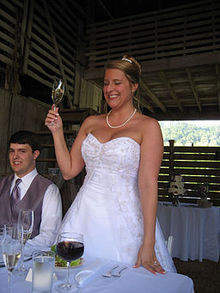
A bride offering a toast at a nuptials
Toasts may be solemn, sentimental, humorous, bawdy,[11] or insulting.[12] The practise of announcing ane's intention to make a toast and signalling for placidity by rapping on the wineglass, while common, is regarded by some authorities every bit rude.[8] Except in very small and breezy gatherings, a toast is offered standing. At a gathering, none should offer a toast to the invitee of honor until the host has had the opportunity to do so. In English-speaking countries, guests may signal their blessing of the toast by saying "hear hear".[13] The person honored should neither stand nor potable,[xiv] but later the toast should rise to thank the one who has offered the toast and take a drink, possibly but not necessarily offering a toast in turn. As toasts may occur in long serial, experienced attendees often make sure to leave enough vino in the glass to permit participation in numerous toasts.[15]
Putting one's glass down before the toast is consummate, or only holding ane'southward glass without drinking is widely regarded equally impolite, suggesting that one does not share the benevolent sentiments expressed in the toast, nor the unity and fellowship implicit in toasting itself.[16] Fifty-fifty the non-drinker is counseled not to refuse to allow vino to be poured for a toast.[17] Inverting the glass is discouraged.[eighteen]
Toasting traditionally involves alcoholic beverages.[xix] Champagne (or at least some variety of sparkling wine) is regarded as peculiarly festive and is widely associated with New Year's Eve and other celebrations.[twenty] Many people nowadays substitute sparkling fruit juice (often packaged in champagne-style bottles[21]), and many authorities consider it perfectly acceptable to participate in a toast while drinking water.[xviii] Toasting with an empty glass may be viewed by some as acceptable beliefs for the not-drinker,[22] though feigning to drinkable from such a glass would probable be seen equally ridiculous. The person giving the toast should never do so with an empty glass, fifty-fifty if the glass contains nil more than water.
Teetotalers may view the drinking of toasts to be abominable and incompatible with their stand, every bit witnessed by this narrative from The Teetotaler (1840):
At the ceremony of Cheshunt College, Sir Culling Eardley Smith was in the chair. This gentleman, after dinner, said "he had subscribed to the Teetotal Pledge, which of class was incompatible with the drinking of toasts;" when the Rev. J. Blackburn, (minister of Claremont Chapel, Pentonville,) said "he was not a teetotaler,—he was not in bondage, [23]—and on that subject he had very recently been preaching." What could the Rev. Admirer mean by this, merely that he had recently been preaching against Teetotalism? Allow the Rev. Gentleman look at drinking community and their enormous evils, and ask himself if he has done his duty; or whether he expects to be pronounced "a good and true-blue servant", if he continues fifty-fifty from the pulpit to encourage the smashing damning evil of this nation. Mr. Donaldson said that he was happy to add, that one of the most popular ministers of the day, the Rev. J. Sherman, gave Mr. B. a pretty severe and well-merited respond, past saying, "His brother Blackburn had said, he (Mr. B.) was not in bondage; he must be immune to say, that he rejoiced that he (Mr. Southward.) had been enabled to break through the old and stupid custom of washing downwards sentiments past draughts of exhilarant liquors. He had thus get a complimentary man. [24]
Mr. Donaldson concluded with some very severe animadversions upon the infamous deport of Mr. Blackburn.[25]
Information technology is a superstition in the Imperial Navy, and thus the Australian, Canadian and New Zealand Navies as well as the United States Navy that a toast is never to be fabricated with water, since the person so honored will exist doomed to a watery grave.[26] During a U.s. Air Strength Dining In, all toasts are traditionally made with wine except for the terminal toast of the night made in honor of POWs/MIAs;[27] because these honorees did not have the luxury of wine while in captivity, the toast is made with water. Some versions of the protocol prescribe a toast in h2o for all deceased comrades.[13]
It is or was the custom in the (British) Royal Navy to drink the Loyal toasts sitting, because in one-time-type wooden warships beneath decks at that place was non plenty headroom to stand upright.
The German word "prost" [edit]

Prosit/Prost [edit]
Prosit is a Latin discussion, meaning roughly "be well", which is a toast in Latin and mod Italian, from which the German short class "prost" is derived. This is a toast in High german. The expression dates back to the beginning of the 18th century when it was used among university students and eventually made its mode into every day language. In a ceremonious context and in connection with a brusque speech, the English word "toast" may as well be used.
The Latin discussion comes from the verb "prodesse" (= "to benefit sth/sb", "to be beneficial"). Consequently, "prosit" is the conjugated grade (3rd person Singular, Present Subjunctive, Active) and therefore an optative: "To y'all/ to your health". Like the colloquial "prost", "prosit" was originally used by university students.[28]
Usage [edit]
In German language, synonyms similar "Wohl bekomm'south!", "Zum Wohl!", and many versions from other languages may also be used instead of "prosit". The acclamation itself is also referred to every bit a "prosit". The verb form is "zuprosten", where the prefix "zu" means that the speech act is targeted at one or several people.
In the Swabian dialect, the word has the farther significant of a belch, called a "Prositle". The acclamation is followed past the clinking of spectacles, often linked to other rules similar making eye contact. This ritual is normally attributed to a medieval custom, whereby one could avoid existence poisoned by one'south drinking companions, as a few drops of each drink got mixed when clinking glasses. There is every likelihood that this did not work. It was much more than effective for one tabular array to share one or more drinking vessels, a procedure which was common for a long time.
In Danish, Swedish, and Norwegian, "prosit" is a approving used in response to a sneeze, in the same way the English expression "bless you" is used.
In Deutschland, toasting, non necessarily past words but commonly just past touching each other'south drinking vessels, is commonly a very closely observed office of culture. In private company, no i should drink a sip of alcohol before having toasted all the other people at the table. In doing this, it is very of import to look directly into the other drinker'due south optics. Not practising this is considered rude and frequently, humorously, believed to attract all kinds of bad luck (eastward.g. "seven years of bad luck" and the like).
Traditional toasts [edit]
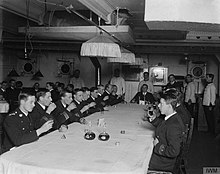
Purple Navy officers in a wardroom seated toasting the King, from a series titled 'The Purple Navy during the Second World War'.
In the British Royal Navy, the officers' noon mess typically began with the loyal toast, followed by a toast distinctive for the day of the week:
- Monday: Our ships at sea.
- Tuesday: Our sailors (formerly Our men but inverse to include women).[29]
- Midweek: Ourselves. ("As no-one else is likely to concern themselves with our welfare" is often the retort and not function of the toast)
- Th: A encarmine state of war or a sickly flavour (pregnant the want and likelihood of beingness promoted when many people die: during war or sickness).
- Friday: A willing foe and sea room.
- Saturday: Our families (formerly "Our wives and sweethearts", with the antiphon of "may they never meet").[29]
- Sun: Absent friends.
The sequence was also prescribed in at least ane publication for the United States Navy.[xxx]
A toast might exist spontaneous and free-class, a carefully planned original speech, or a recitation of traditional sentiments such as this Irish gaelic case:[31]
May the road ascent to meet you.
May the current of air be always at your dorsum.
May the sun shine warm upon your face.
And rains autumn soft upon your fields.
And until we run into again,
May God hold you in the hollow of His paw.
An informal variation of the last two lines:
And may ye exist in Heaven a half-hour
afore the devil knows ye're dead!
Toasts worldwide [edit]
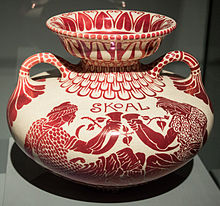
In diverse cultures worldwide, toasting is common and to not do and so may exist a alienation of etiquette. The general theme of a toast is "skillful luck" or "skilful health". At formal meals in sure countries of the Commonwealth of Nations, the start toast to be proposed is traditionally the Loyal Toast ("The Queen"). This may be adapted in other countries to requite a loyal toast to the appropriate Head of State.[xv]
Selected examples of toasts worldwide:
- Albanian: "Gëzuar" (enjoy)
- Afrikaans: "Gesondheid", "Tjorts", or "Tjeers" (to good health, thanks, or bottoms up!)
- Amharic language (Ethiopia): "Le'tenachin!" (to our health)
- Arabic: "بصحتك" (be ṣaḥtak, for your health)
- Armenian: "Կենաց" or "Կենացդ" (kenats/genats or kenatst/genatst, "to life" or "to your life")
- Australian English: Cheers mate! (to your happiness my friend)
- Basque: "Topa!" (toast)
- Belarusian: "Будзьма!" (budzma, may we live!)
- Bosnian: "Nazdravlje" (to wellness) or "Živjeli" (alive!)
- Bulgarian: "Наздраве" (nazdrave, to health)
- Catalan: "Salut!" (to health), "Brindem" (to toast), "Xin-xin" (as emulating the audio of the glasses), "Salut i força al canut!" (traditional phallic rhyme, significant "wellness and strength to the dick"), "Brindem, brindem, brindola, pels nostres pits i la vostra titola" (variation including tits and dick), "Salut i peles!" (health and money, as popularized by the translation in Catalan of the British series Bottom).
- Chinese:
-
- Mandarin: "乾杯" (gānbēi, lit. "Empty the glass", similar to "bottoms upwards" in English), "請請" (qing qing, lit. "Please, delight," said by host when inviting guests to potable, fig. every bit emulating the sound of the glasses)
- Cantonese: "飲杯" (yam2 bui1, lit. "Beverage the glass", similar to "bottoms up" in English), "飲勝" (yam2 sing3, lit. 'Drink for victory')
- Hokkien/Taiwanese Hokkien: "予焦啦" (hōo ta--lah, "Empty the glass", like to "bottoms up" in English)
- Cornish: "Yeghes da!" (Cheers!)
- Croatian: "Živjeli" (alive!), "Nazdravlje" (to health)
- Czech: "Na zdraví" (to health)

- Danish: "Skål" (lit. "basin", refers to older drinking vessels)
- Dutch: "Proost" (from Latin prosit "may it be good" (i.e., for you)), or "(op je) gezondheid" ((to your) health); in Belgium: schol (from Scandinavian) or santé (from the French).
- English: "Thanks", "Bottom's up", "Mentum-chin" (dated, from Chinese qing qing [32]).
- Esperanto: "Je via sano!" (to your health)
- Estonian: "Terviseks" (for the wellness) or "proosit" (from German language "Prost")
- Filipino: "Mabuhay" (long live); "Tagay" ([let us] drink); "Kampay" (from Japanese kanpai); the Philippines does non historically have a toast, because social drinking of booze traditionally involves the sharing of one cup amongst participants (a tagayan)[33]
- Finnish: "Kippis", "Skool",[34] "Pohjanmaan kautta", or "Hölökyn kölökyn" (in Savonian dialects)
- French: "Tchin tchin" (from Chinese qing qing), "Santé" (health) or "cul sec" (lit. "dry bottom", to drink the whole glass in one go)
- Galician: "Saude" (Adept health)
- Georgian: "გაუმარჯოს!" (Gaumarjos!) (Victory!)
- German: "Prost", "Prosit", from Latin prosit (may it be expert (i.e., for you)) or "Zum Wohl" (to health)
- Greek: "Εις υγείαν" (is iyían), "στην υγειά σου/μας", "γειά" (for health) or "Εβίβα" (eviva, from Italian evviva, "long life!")
- Hebrew: "לחיים" ("L'Chayyim") (to life, traditional Jewish toast)
- Hindi: "अच्छी सेहत" (achchee sehat, "good health")
- Hungarian: "Egészségünkre" (for our health), more than commonly "Egészségedre" [ˈɛgeːʃːeːgɛdrɛ] (to your health), "Fenékig" (lit. "to the bottom", similar to "bottoms up" in English)

a toast in Lisbon, Portugal
- Icelandic: "Skál" (lit. "bowl", referring to older drinking vessels)
- Irish: "Sláinte" (health)
- Italian: "Prosit" (from the Latin), "Cin Cin" (from Chinese qing qing) or "Salute" (wellness)
- Japanese: "乾杯" (kanpai, lit. "Empty the glass", like to "bottoms upwards" in English)
- Korean: "건배" ("乾杯", geonbae, lit. "Empty the glass", similar to "bottoms up" in English language), "짠" (jjan, slang discussion imitating glasses clinking together)
- Latin: "Vives" ("may you live), often in the Greek form ZHCAIC given in Latin letters as ZESES;[35] "Prosit" or "Propino"
- Latvian: "Priekā" (to joy)
- Lithuanian: "Į sveikatą" (to health)
- Macedonian: "На здравје" (na zdravje, to health)
- Maltese: "Saħħa" (wellness)
- Manx: "Slaynt" (health) or "Slaynt vie" (expert health)
- Māori (NZ): "Mauri ora" (to life)
- Marathi: "Chang bhala" (may it be skilful)
- Mexican Spanish: "Salud" (to health) or "Saludcita" (to health, diminutive)
- Nepali: "तरङ्ग" ("tarang", 'moving ridge')
- Norwegian: "Skål" (lit. "bowl", referring to older drinking vessels)
- Persian: "به سلامتی" (Be salamati, "skillful health" )
- Polish: "Na zdrowie" (to health), "Twoje zdrowie" (to your health, singular) or "Wasze zdrowie" (to your health, formal and/or plural)
- Portuguese: "Tchim-tchim" (from Chinese qing qing) or "Saúde" (wellness)
- Romanian: "Noroc" (good luck) or "Sănătate" (health)
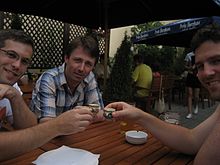
- Russian: "Ваше здоровье!" (Vashe zdorov'ye, to your wellness) or "Будем здоровы!" (Boodiem zdorovy!, let's be healthy!) or only "Будем!" (Boodiem!, let's be [good for you]!)
- Scottish Gaelic: "Slàinte mhath" (good health)
- Serbian: "Uzdravlje" (to health) or "Živeli" (live!)
- Slovak: "Na zdravie" (to health)
- Slovene: "Na zdravje" (to wellness)
- Spanish/Castilian: "¡Chinchín!" (onomatopoeic for clinking of glasses[36] or "¡Salud!" (health). In Republic of chile, the diminutive "¡Salucita!" is oft employed.
- Swedish: "Skål" (lit. "bowl", referring to older drinking vessels[37]); Gutår ("proficient year", erstwhile fashioned, nonetheless used in formal settings)
- Swiss High german: "Proscht" (every bit in German language "Prost") or as diminutive form "Pröschtli"
- Thai: "ชัยโย" (chai-yo!, lit. "Hurrah!") or "ชนแก้ว" (chon-kaew, lit. "knock spectacles") or "หมดแก้ว" (mod-kaew, lit. "Bottoms up")
- Turkish: "Şerefe" (to honor)
- Ukrainian: "За здоров'я" or "Ваше здоров'я" (Za zdorovya, to health, or Vashe zdorovya, to your health)[38] or "Будьмо" (Budmo, let us be)
- Vietnamese: "Dô" or "dzô" ((take) in)
- Welsh: "Iechyd da (i chi)" (Skillful health (to you))
See likewise [edit]
- "Champagne for my real friends, real pain for my sham friends"
- Roast (comedy)
- Tamada
- Toastmaster
- Toastmasters International
- Toasts of the Royal Navy
- Types of speeches
References [edit]
- ^ "Toast: The Babies". Etext.virginia.edu. 2005-09-01. Retrieved 2012-04-16 .
- ^ "Why Nosotros Clink Wine Glasses". snopes.com. Retrieved 2012-04-16 .
- ^ "toast". Lexicon.com Unabridged (v 1.1). Random Business firm, Inc. Retrieved 2007-08-25 .
- ^ Harper, Douglas (2001). "toast". Online Etymology Dictionary . Retrieved 2007-08-25 .
- ^ Heath, Dwight B. (1995-01-01). International Handbook on Alcohol and Civilization – Google Books. ISBN9780313252341 . Retrieved 2012-04-16 .
- ^ Boswell, Sandra. Protocol Matters: Cultivating Social Graces in Christian Homes and Schools. Canon Press, 2007 p. 140
- ^ "Wedding ceremony Congratulations". Wedding ceremony Congratulations. 2012-02-09. Archived from the original on 2012-05-07. Retrieved 2012-04-16 .
- ^ a b "Toasting |". Toastchampagne.co.britain. 1911-05-31. Archived from the original on 2008-07-25. Retrieved 2012-04-16 .
- ^ "More Samples of Wedding Toasts". Weddings.most.com. 2012-04-09. Retrieved 2012-04-sixteen .
- ^ "Home of the bean and the cod". The Daily Telegraph. London. 2002-12-22. Archived from the original on Baronial 6, 2010. Retrieved 2010-05-25 .
- ^ "Archived copy". Archived from the original on 2011-07-22. Retrieved 2010-01-eighteen .
{{cite web}}: CS1 maint: archived copy every bit title (link) - ^ "Archived re-create". Archived from the original on 2011-07-22. Retrieved 2010-01-18 .
{{cite web}}: CS1 maint: archived re-create as title (link) - ^ a b "Air Forcefulness Dining". Jmarprotocol.com. Retrieved 2012-04-xvi .
- ^ Goose45 (16 March 2007). "A Guide To Toasting". Into Wine. Retrieved 2012-04-16 .
- ^ a b "Royal Navy Toast". Hmsrichmond.org. Retrieved 2012-04-16 .
- ^ "Wedding Tradition History, Customs, Etiquette". Bkthedj.com. Retrieved 2012-04-16 .
- ^ "Test Your Concern Etiquette". Archived from the original on 2011-06-14.
- ^ a b Sih, Melinda (1998-02-01). "Minding manners at dinner serves you well in business".
- ^ "Can you lot toast with non-alcoholic drinks?".
- ^ Robert J Douglas (2007). "Champagne: the safer choice for celebrations". BMJ. 335 (7633): 1281. doi:ten.1136/bmj.39419.449942.Ad. PMC2151173. PMID 18156226. Retrieved 2012-04-16 .
- ^ "Juice – Sparkling Juice – Meier's Wine Cellars Inc – Cincinnati – Ohio". 39.1953; -84.4006: Cincinnatisparklingjuices.com. Archived from the original on 2012-03-02. Retrieved 2012-04-16 .
{{cite spider web}}: CS1 maint: location (link) - ^ "Eugene Register-Guard – Google News Archive Search".
- ^ Galatians five:1 -¶ "Stand fast therefore in the liberty wherewith Christ hath made us gratis, and be not entangled once again with the yoke of bondage." (KJV)
- ^ 2 Peter two:19 – "While they promise them liberty, they themselves are the servants of corruption: for of whom a man is overcome, of the same is he brought in bondage." (KJV)
- ^ Reynolds, George Westward. Thou., ed. (1840-07-25). "The Teetotaler". I (5). London: United Temperance Association: 38. Retrieved 2011-12-09 .
he had subscribed to the Teetotal Pledge, which of course was incompatible with the drinking of toasts;
- ^ chicago_blogger (2009-11-28). "The Vino Historian: A Traditional US Navy Vino Toast". Thewinehistorian.blogspot.com. Retrieved 2012-04-xvi .
- ^ "MilitaryWives.com Network". Airforcewives.com. Retrieved 2012-04-16 .
- ^ Prosit, colloquial prost in DUDEN, German Monolingual Lexicon Online
- ^ a b "'Our wives and sweethearts' Naval toast rewritten". www.BBC.co.uk. BBC News. 2013-06-22.
- ^ US Navy's Mess Night Transmission, Naval School, Civil Engineer Corps Officers, Port Hueneme, California, August 1986.
- ^ "The Tales of Tanglewood: Irish gaelic Sayings, Blessings & Toasts". Talesoftanglewood.blogspot.com. 2008-07-07. Retrieved 2012-04-sixteen .
- ^ "Definition of chin-chin in English". Lexico. Oxford University Press/Dictionary.com. Retrieved 16 September 2019.
- ^ Gideon Lasco. "Tagay: why there'due south no word for "cheers" and other notes on Filipino drinking culture".
- ^ Kippis, skool ja Pohjanmaan kautta (in Finnish)
- ^ Weitzmann, Kurt, ed., Age of spirituality : late antiquarian and early Christian fine art, third to seventh century, nos. 347–viii, 377, 1979, Metropolitan Museum of Art, New York, ISBN 9780870991790; full text bachelor online from The Metropolitan Museum of Art Libraries
- ^ chinchín (tertiary pregnant) in the Diccionario de la Real Academia Española. It is attributed an English and before Chinese origin.
- ^ "skål | SAOB".
- ^ Словник української мови (Академічний тлумачний словник в xi томах). Інститут мовознавства АН УРСР. Київ, "Наукова думка", 1970—1980. Том three (1972), с. 548. Online version: ЗДОРО́В'Я, том 3, с. 548. (Dictionary of Ukrainian Linguistic communication. Constitute of Linguistics of the Ukrainian University of Sciences. Kiev, Naukova Dumka, 1970−1980. Vol. 3 (1972), p. 548)
External links [edit]
 | Wikimedia Commons has media related to Toasting. |
 | Wikiquote has quotations related to: Toasts |
- Make a toast in 50 other languages
- More multilingual toasts
- . New International Encyclopedia. 1905.
Source: https://en.wikipedia.org/wiki/Toast_(honor)

إرسال تعليق for "If We Meet Again Lets Have a Drink and You Can Tell Me About This Woman Named Russianã¯â»â¿"